A symposium titled Nguyen Huy Thiep and the Legacy He Left Behind, organized by Nha Nam Publishing House, has become one of the notable events in Vietnam’s contemporary literary life.
In the memory of Vietnamese literature, Nguyen Huy Thiep remains a singular presence through prose that was sharp, uncompromising, and deeply engaged with the complexities of human life.
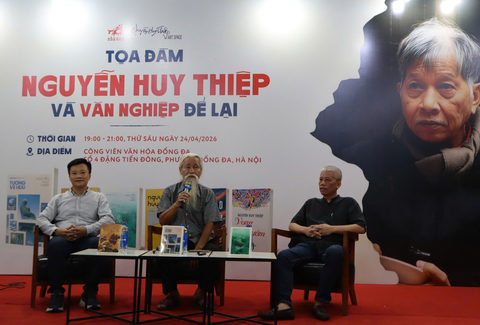
Cap1: Speakers at the symposium.
Portraying one of the pioneers of Vietnam’s Doi moi-era fiction, however, requires more than simply revisiting his works. It also means listening to those who followed, debated, and reflected on his writing over many years. The symposium therefore served not only as an academic forum, but also as a space of memory and literary reflection, with the participation of writer Nguyen Viet Ha and literary critics Pham Xuan Nguyen and Mai Anh Tuan.
Drawing from personal encounters and long observation, the speakers approached Nguyen Huy Thiep not merely as a subject of criticism, but as a living literary presence whose works continue opening new readings and interpretations today.
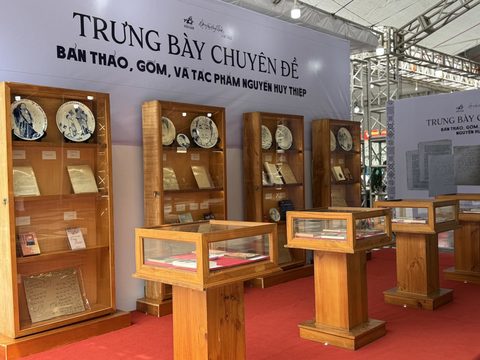
A corner of the exhibition space.
As part of the event, Nha Nam collaborated with the writer’s family to organize a special exhibition titled Manuscripts, Ceramics and the Works of Nguyen Huy Thiep. Beyond the discussions, the exhibition offered audiences a more intimate way to approach the writer’s creative journey.
The display was organized around three main themes. The first featured handwritten and typed manuscripts, including important works such as Truong Chi, the essay Literature Is Life, letters sent to newspapers, and notes written during his final years on pieces of cardboard while struggling with illness. These materials revealed not only his creative process, but also the literary atmosphere of Vietnam’s Doi moi (Renewal) period.
The second section introduced ceramic works created by Nguyen Huy Thiep himself, including portraits of relatives, fellow artists, and self-portraits. Through clay rather than language, the writer seemed to continue his dialogue with the world.
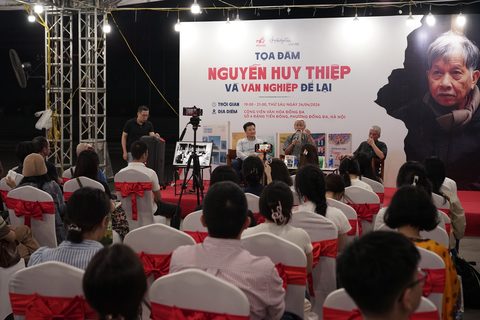
Inside the symposium venue.
The third section traced the publishing history of his works from 1988, when The General Retires first appeared, to later editions in Vietnam and abroad. Speakers noted that few Vietnamese writers have been continuously republished by major publishers in such diverse and special editions.
According to Mai Anh Tuan, the enduring power of Nguyen Huy Thiep’s literature lies in the universal questions he raised about human destiny, morality, and society. His works continue generating new generations of readers and critical discussions, refusing to settle into a fixed interpretation.
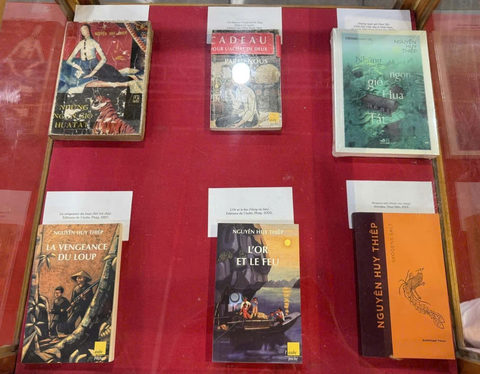
Nguyen Huy Thiep’s works published in multiple countries.
Pham Xuan Nguyen described Nguyen Huy Thiep’s emergence during the Doi moi era as a turning point in Vietnamese literature. His direct, cold, and fearless prose reshaped literary language and challenged conventional ways of writing. Writer Nguyen Viet Ha added that works such as Sharp Sword, Gold and Fire, and Chastity established an unmistakable literary voice through irony, realism, and layered symbolism.
More than four decades after his literary debut, Nguyen Huy Thiep’s works continue to move readers, especially younger generations seeking honesty, courage, and creative intensity in literature.
His influence has also reached beyond Vietnam, with works translated into French, English, Italian, German, South Korean, and other languages. Remarkably, speakers noted, this international presence came not through promotion campaigns, but through the enduring strength of the writing itself.
Translated by DO HUONG
VNQD